As someone who has been in the procurement world over shy of a decade, I have learnt that negotiations do not go always as planned if not prepared correctly. You can have leverage, volume and good market conditions and still fail. why ? Because negotiation is not about power, its about the right incentives. and That’s why understanding game theory becomes essential in procurement.
Every negotiation is a game between two players (most of the times) :
- The buyer
- The supplier
And each players has :
- Objectives
- Constraints
- Alternatives
- Risk Exposure
If you engage a negotiation without having in idea about all the parties involved, you have a high chance it being absolutely unpredictable.
Define your objectives
Clearly defining your objectives would determine your strategy and then you actions, without proper definition your negotiation will drift, and you cannot measure whether you have succeeded or not.
- what is your target price ?
- Type of deal ? short term cost optimization ? or long term parternship
- Other than financial gain, operational gain ? risk management ?
- Surviving a near market shift ?
Size Yourself, know your real weight
You may feel like a big customer, but in the supplier portfolio you maybe small. and that alone changes your posture and how you handle the game. In procurement terms, that means answering questions that are simple but give clarity about your position.
- How much business am I brining to the table ? compared to their total turnover.
- For how long ? time frame is important
- Type of business ? new opportunity or supplier change
- The stakes at hand, is this transactional or strategic ?
Having these questions answered defines your strong points and leverage.
Size your opponent
You need to know your suppliers as much as you can, try to put yourself on their shoes. this will be an eye opener and will you connect quickly with the right incentives to push the right buttons.
- What is their annual turnover ?
- Company progress, growing or shrinking ? this can be observed if they are currently investing or cutting down cost.
- % of you business compared to their total turnover
- How much capacity they have left ? is there in room for you within the project timeframe.
After step 1 & 2, you can already tell if your objectives align with your suppliers trajectory and whether it will an easy negotiation or a tough one.
Alignment vs Misalignment : two different games
Lets discuss some real life examples that I have faced in the past with two different scenarios :
| Scenario A: Supplier needs the business | Scenario B: The Supplier is at full capacity |
| A large project was canceled. Supplier has 30% capacity left. Your contract fit within that capacity . In this case, your business solves a problem for them. In game theory we call this a positive-sum game. both parties get benefit from cooperating together. the supplier’s behavior will include : Competitive pricing Faster responses Higher flexibility real engagement. if your targets are reasonably defined within the market range and because the incentives are aligned, you are most likely to get a good deal. | Supplier is at 98% Capacity They prioritize high-margin customers You bring in 3% if their turnover Accepting your contract create operational stress In this position the natural reaction would either to decline the business or give you very high prices. not because they dislike you, but mainly because strategically your contract has a lower payoff than rejecting it. unless the price given compensates for the disruption. this is rational behavior. that’s why sizing your opponent is important as stated above. having these information would have directed you to another suitable supplier. |
The Zone of Possible Agreement (ZOPA) :
In game theory, a deal takes place if there is an overlap between what is the buyer is willing to pay, and what the supplier is willing to accept. this overlap is called the ZOPA.
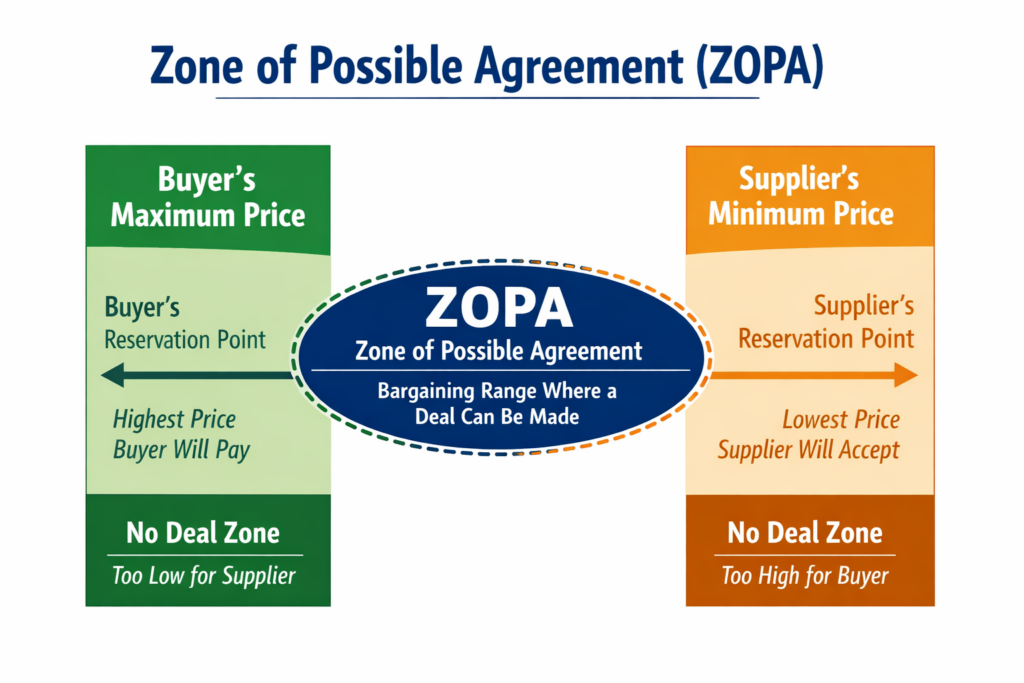
If the buyer’s maximum price is lower than the supplier’s minimum acceptable price, there is no agreement to be made. No negotiation technique can fix a structural gap. But when the buyer’s maximum exceeds the supplier’s minimum, a bargaining range exists, and a deal becomes possible.
The size and position of this zone depend on context. Capacity constraints, urgency, alternatives, and market conditions can all shift the limits on either side. And even when a ZOPA exists, the goal is not to push to the extreme edge. Sustainable agreements sit within the zone in a way that both parties consider acceptable over time.
Negotiation is about Incentives, not power
Game theory in procurement is not about complex mathematics. It is about understanding motivations and structuring incentives correctly. The best negotiation is not the one you “win” today, but the one both sides are still satisfied with three years later. In an industrial environment, changing suppliers is never simple. Resourcing takes months, sometimes years. It requires new qualifications, technical validations, audits, testing, and internal approvals. That process consumes time, energy, and risk capacity.
This is why long-term relationships matter. A stable, balanced agreement reduces disruption and protects operational continuity. And that stability starts long before the first meeting, it starts with understanding the game properly.